Trending publication
The Real Impact (Fall 2026)
Print PDFIn This Issue
Whether charitable dollars move through a grant or an investment, they have to adhere to the rules that define what counts as charitable. This fall, we look at two places where those rules matter:
Exemption on the Line: Proposed Regulations Would Strip Exemption From Private Schools With Race-Based Programs
Treasury and the IRS have proposed regulations that would deny section 501(c)(3) status to private schools that discriminate on the basis of race, color, or national or ethnic origin. Comments are due November 3, 2026. Relevant to schools, donors, and other charitable organizations.
Program Related Investments Explained for Private Foundations: Making Qualifying Distributions Through Investments
A program related investment lets a private foundation put capital to work for charitable purposes while also counting toward its required 5% annual distribution. Relevant to foundations and impact investors.
Exemption on the Line: Proposed Regulations Would Strip Exemption From Private Schools With Race-Based Programs
On September 4, 2026, the Department of the Treasury (“Treasury”) and the Internal Revenue Service (the “IRS”) published proposed regulations (the “Proposed Regulations”) that would deny section 501(c)(3) status to any private school that discriminates on the basis of race, color, or national or ethnic origin. The Proposed Regulations would end the long-standing allowance for race-conscious admissions, scholarships, and other programs designed to promote diversity or remedy past discrimination. A school that keeps such a program would not qualify as a tax-exempt charity. The Proposed Regulations would apply to taxable years beginning after May 31, 2027. Comments are due November 3, 2026, and Treasury and the IRS have scheduled a public hearing for December 2, 2026.
The Proposed Regulations apply only to private schools, but the concern across the charitable sector is that the effect may not stop there. The rationale for the Proposed Regulations is that race-based discrimination for any purpose violates fundamental public policy, a principle that is not limited to schools. Private schools, along with other charities that run race-conscious programs, including grantmakers, scholarship funds, and service providers, will want to track these developments closely.
Eliminating the Purpose Distinction
The IRS has long taken the position, affirmed by the Supreme Court in Bob Jones University v. United States, that a private school with a racially discriminatory policy does not qualify as a charity because such discrimination is contrary to public policy. That case involved one school that admitted almost only white students and another that barred interracial dating and marriage. Until now, the position has turned on the school’s purpose for any race-based programming. Since 1975, IRS guidance has said that a school program favoring racial minority groups in admissions, facilities, or financial aid is not discrimination if it is designed to promote the school’s nondiscriminatory policy. The Proposed Regulations would eliminate that distinction; any race-based criteria would be a basis for disqualification. The rule would also move from IRS guidance into the regulations, which gives it greater weight and durability.
Key Features of the Proposed Regulations
Two features of the regulatory text are worth noting. First, the Proposed Regulations contain no minimum threshold and no mechanism for a school to correct a problem and keep its exemption. Second, they do not define “discriminates,” and they do not say whether or when a facially neutral criterion adopted to produce a particular racial outcome would be treated as discriminatory.
The explanatory preamble adds context that does not appear in the regulatory text:
- Religious schools. The preamble states that the Proposed Regulations would not stop a school from maintaining a religious mission or selecting students on the basis of religious affiliation, provided the criterion is based solely on religion and not on shared ancestry or ethnic characteristics.
- Race-neutral alternatives. The preamble states that Treasury expects that schools will replace race-based criteria with criteria such as income, geography, or first-generation status, and confirms that schools may continue to combat prejudice and discrimination by means that do not themselves discriminate on these bases.
- Donor-restricted funds. The preamble acknowledges that schools may need to work with donors or their heirs to revise race-based eligibility criteria in gift instruments. The proposal offers no relief for these funds beyond the delayed applicability date.
Implications for Exemption
The Proposed Regulations do not create a new way to revoke a school’s exemption. They add a condition for qualifying: a school that does not satisfy the nondiscrimination requirement is not a tax-exempt charity for that year. Neither the Proposed Regulations nor the preamble says how the requirement would be enforced.
If a school were to lose its exemption, the consequences could be significant. Its income could become subject to federal income tax, contributions to it would no longer be tax-deductible, and it could lose access to tax-exempt bond financing available only to section 501(c)(3) borrowers. Loss of exempt status could also affect bonds already outstanding. Donors and grantmakers that support the school, including those that fund scholarships with race-based eligibility criteria, would need to reassess those gifts.
For private foundations in particular, the question is how to continue supporting a school or scholarship program if its charitable status were in doubt. A grant to an organization that is not a section 501(c)(3) organization generally requires the foundation to exercise expenditure responsibility, the same mechanism described in the program related investment article below.
Where Do We Go From Here?
The Proposed Regulations are not final, and Treasury and the IRS expect to finalize them before the first covered taxable year begins. Groups have announced plans to challenge them, and they could be modified or delayed, so schools should weigh the cost and timing of any changes against that uncertainty. Schools can use the time before the rule takes effect to prepare, and we recommend the following steps:
- Inventory every policy or program that takes account of race, ethnicity, or national origin. The review should extend beyond admissions and financial aid to recruitment, athletics, prizes, mentoring, affinity programming, and faculty and staff initiatives.
- Review gift instruments for restricted funds that use racial, ethnic, or national-origin criteria. Some can be amended with the donor’s consent. Others may require court approval, which takes time. A careful review of the relevant gift instruments is needed here, and we can help.
- Seek experienced counsel. Informed by the results of the policy and program inventory and restricted fund review, our team can discuss whether any modifications to policies, programs, or restricted funds should be explored before the Proposed Regulations are finalized or whether waiting makes more sense.
- Identify the first covered taxable year. A school with a June 30 fiscal year end is first covered in the year beginning July 1, 2027. A calendar-year school is first covered in the year beginning January 1, 2028.
Although charities that are not schools would not be subject to the Proposed Regulations, those that run programs with race-based eligibility criteria should still consider these steps now and watch whether Treasury and the IRS extend the same approach to other section 501(c)(3) organizations
Program Related Investments Explained for Private Foundations: Making Qualifying Distributions Through Investments
The question of what counts as charitable arises on the investment side as well. For private foundations, a program related investment is one way to deploy capital toward charitable goals while preserving the ability to recycle it.
What Is a Program Related Investment?
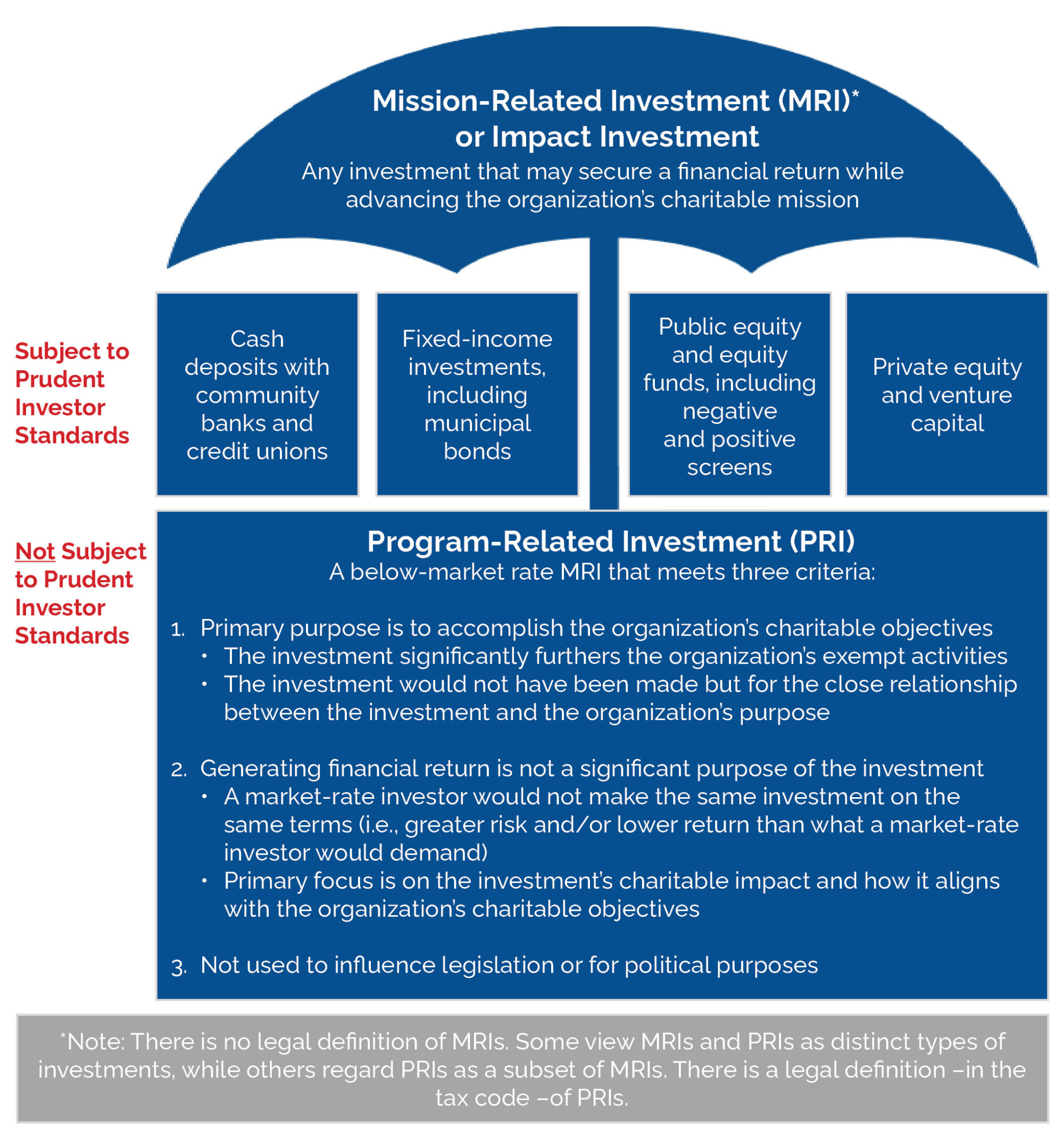
A program related investment (a “PRI”) allows a private foundation to broaden the use of its resources beyond traditional grantmaking. Through a PRI, a foundation can promote its charitable agenda while retaining an economic interest in a recipient entity and often is able to recycle resources in a future grant or investment. PRIs take the form of below-market loans, loan guarantees, lines of credit, and equity investments. Foundations often make a PRI to enable an organization to engage in an activity it would not otherwise be able to undertake. For example, providing capital to an organization may allow an organization to do work or research that it otherwise could not do. Both for-profit and nonprofit organizations may be recipients of PRIs, so long as the investment furthers the achievement of a specific charitable goal.
If an investment qualifies as a PRI for federal income tax purposes, the foundation manager will not be required to show that ordinary business care and prudence was exercised in making the investment. This protection from ordinary prudence standards allows foundation managers to make investment choices driven by charitable outcomes rather than financial outcomes.
How Does an Investment Qualify as a PRI?
The three criteria for qualifying as a PRI are:
- the primary purpose of the investment must be to accomplish one or more charitable purposes;
- producing gain may not be a significant purpose behind the investment; and
- the funds may not be used by the recipient organization for political lobbying or campaigning.
To establish that the primary purpose of a PRI is charitable, a foundation must demonstrate that the investment significantly furthers the accomplishment of charitable activities. A foundation must also show that the investment would not have been made but for the relationship between the investment and the future accomplishment of the charitable activities. Although a PRI may be made for any charitable purpose, a foundation must determine that the purpose of a PRI is specifically within the scope of its charitable purposes. For example, a foundation whose stated purpose is to further education cannot make an investment in an organization that does medical research. Contemporaneous documentation of the reasons for making a PRI will allow a foundation to establish this information at a later time.
While the fact that an investment results in the production of income or the appreciation of property does not disqualify it as a PRI, a foundation must demonstrate that the production of gain is not one of its significant goals in making the investment. Investments, such as equity investments in a new company that is entering an undeveloped market, either directly or through a fund would also qualify. An investment in a venture capital fund operated with dual financial and charitable objectives may also qualify as a PRI. The possible profit-making of a fund recipient does not impact the satisfaction of this criteria.
The final condition for PRI status is that the recipient organization is prohibited from using the investment for political lobbying or campaigning. Essentially, the recipient must agree not to engage in activities that the foundation would not be able to undertake itself. To fulfill this condition, the foundation should add provisions to this effect in the investment agreement.
What Are the Tax Consequences of a PRI?
A foundation that makes a PRI generally can treat the amount of the loan or equity investment and the administrative cost of making the investments as a qualifying distribution.
When a PRI is made to an organization that is not a 501(c)(3) organization, the foundation must exercise expenditure responsibility to ensure that the investment is, in fact, used for charitable purposes. That is accomplished by signing an agreement between the foundation and the PRI recipient that states the purpose of the investment and whereby the PRI recipient agrees:
- to use all the funds for the stated purpose and to return any funds not used for such purpose;
- to provide annual financial records of the type required by commercial investors and an annual statement that it has complied with the terms of the investment;
- to maintain and make available to the foundation books and records of the type ordinarily required by commercial investors; and
- not to use any of the funds for political lobbying or campaigning purposes.
The foundation is responsible for reporting to the IRS for as long as it is required to receive reports from the recipient.
About Nutter’s Nonprofit and Social Impact Practice Group
Nutter’s Nonprofit and Social Impact Practice Group provides a wide range of services to nonprofit organizations, individuals, and businesses utilizing an interdisciplinary team approach that focuses on each client’s specific needs. We counsel healthcare, educational, human services, religious, and cultural institutions, as well as donor advised funds, corporate and family foundations, and generations of philanthropic families. Our reach expands beyond charitable organizations to include trade associations, chambers of commerce, social welfare organizations, social clubs, and for-profit enterprises intent on developing or enhancing their philanthropic strategies.
This communication is for informational purposes only and should not be construed as legal advice on any specific facts or circumstances. Under the rules of the Supreme Judicial Court of Massachusetts, this material may be considered as advertising.