Trending publication
2026 Year-End Charitable Planning: What Donors Should Know Before Giving Tuesday
Print PDFGiving Tuesday falls on December 1 this year, the first year-end under the new federal charitable deduction rules, which took effect on January 1, 2026. Whether you give a few hundred dollars or a few hundred thousand, how and when you give may now change what your gifts cost you after tax.
Below is an overview to help you decide how to give before the end of the year and how to maximize both the impact of your gifts and your tax savings as Giving Tuesday approaches.
What Changed in 2026
The One Big Beautiful Bill Act (the “OBBB”) changed four rules that affect individuals’ charitable gifts made beginning in 2026:
- The 0.5 percent floor. Taxpayers who itemize may deduct charitable gifts only to the extent the gifts exceed 0.5 percent of adjusted gross income (“AGI”) for the year. For a donor with $1,000,000 of AGI, the first $5,000 of giving generally produces no federal deduction.
- A 35 percent cap. Donors in the 37 percent bracket now receive a federal benefit of roughly 35 cents, rather than 37 cents, for each dollar of itemized deductions, including charitable gifts.
- The 60 percent cash limit, made permanent. Cash gifts to public charities remain deductible up to 60 percent of AGI. Any excess carries forward for five years.
- A deduction for taxpayers who do not itemize. Taxpayers who take the standard deduction may deduct up to $1,000 ($2,000 for married couples filing jointly) of cash gifts to public charities. Gifts to donor-advised funds (“DAFs”), private foundations, and supporting organizations do not qualify.
Together, these changes reduce the value of small, steady gifts for donors who itemize, and they make the timing and form of larger gifts more important. For donors who do not itemize, a Giving Tuesday gift made directly to an operating charity may now carry a modest tax benefit.
Bunching: Concentrating Several Years of Giving in One Year
Bunching means combining several years of giving into a single year. A DAF makes this practical: you contribute several years’ worth of gifts at once, take the deduction now, and recommend grants to charities over time. Contributions to a DAF are irrevocable, so the strategy works best for giving you already plan to do. For donors who itemize every year, bunching also limits the effect of the new 0.5 percent floor: because the floor applies to each year’s giving, concentrating gifts in one year means it reduces your deduction once rather than several times. For most donors, the amount disallowed by the floor is lost rather than carried forward to a later year.
Consider a married couple with $1,000,000 of AGI who give $50,000 in cash to public charities annually. The floor is $5,000, so each year’s gifts produce a $45,000 federal deduction.
If instead the couple contributes $200,000 to a DAF in the first year and recommends $50,000 in grants each year, the charities receive exactly the same amounts, but the floor applies only once:

Bunching adds $15,000 of deductions over four years, worth about $5,250 of federal tax at roughly 35 cents on the dollar. The example is simplified, is limited to federal tax, and assumes the same AGI each year. The example also assumes the couple itemizes every year and all gifts are cash to public charities within the 60 percent limit.
Opening a Donor-Advised Fund or Forming a Private Foundation
If you expect to give more than one year’s worth of gifts, you may be wondering whether to open a DAF or to form a private foundation. A DAF is an account held by a public charity, called the sponsor. You make an irrevocable gift to the account, take the deduction in the year of the gift, and then recommend grants to charities over time. The sponsor holds legal control of the account but almost always follows your recommendations (assuming the grant is to a qualifying charity). Many sponsors can open an account in a matter of days, though a transfer of securities to a new account takes longer.
A private foundation is a separate charitable organization that you and your family control through its own board. It offers the most control over how gifts are invested and granted, and it can make grants to individuals and other recipients with a few additional steps. It also requires an IRS application, annual tax returns, and state filings. All foundation grants, officers, and assets are public.
A foundation can be formed before year-end. We can prepare the organizing documents, obtain a taxpayer identification number, and open accounts to receive gifts before December 31. If we then timely file an application for tax-exempt status that is approved by the IRS, gifts made to the foundation from the date it was formed are tax-deductible. Whichever structure you choose, the gift must be complete by December 31, and gifts of certain types of assets require significant lead time.
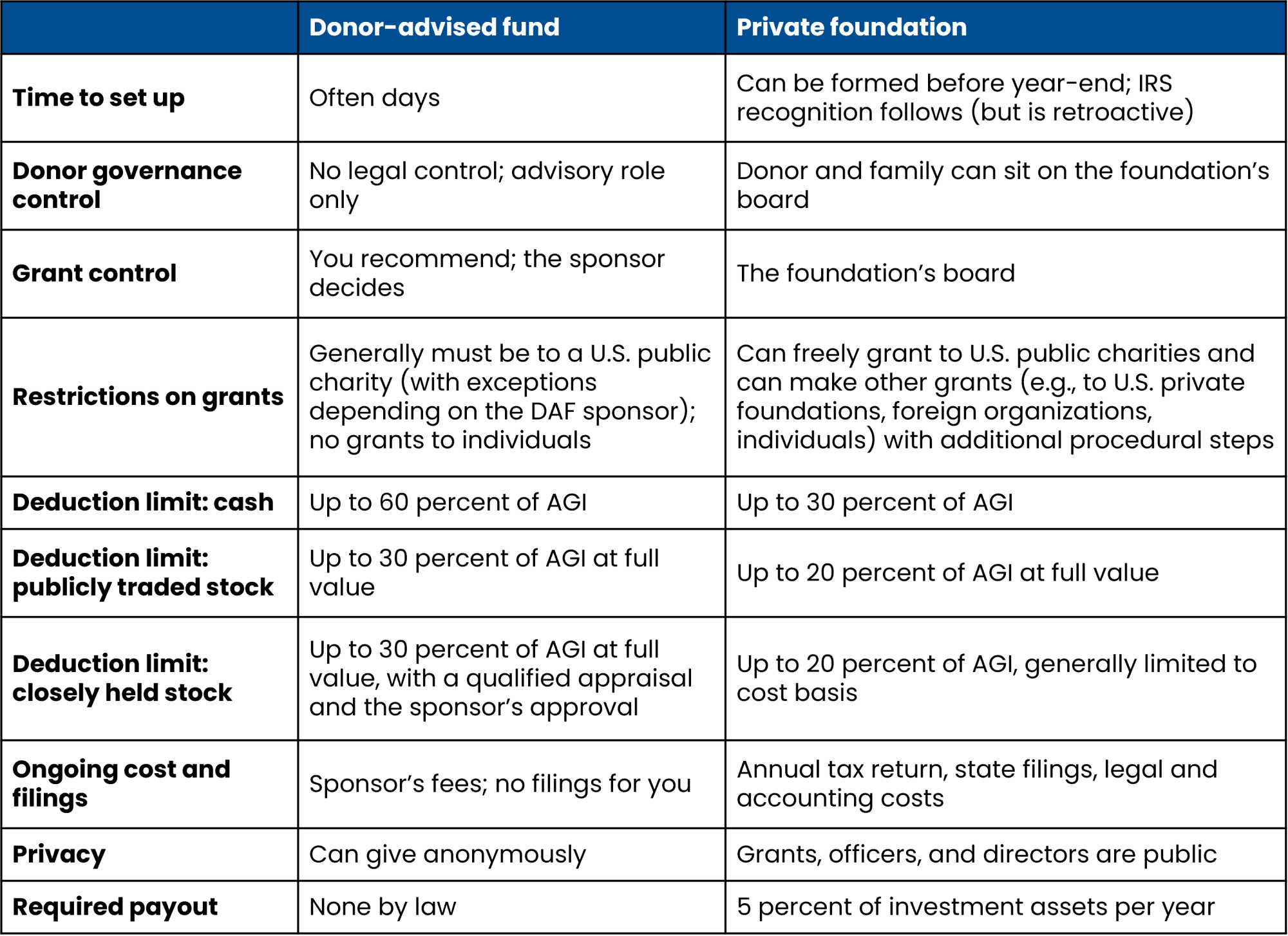
Both structures are subject to the 2026 changes described above.
Giving Appreciated Stock Instead of Cash
If you own stock or other securities that have increased in value and that you have held for more than one year, giving the shares directly to a charity or a DAF, rather than selling them and giving the sale proceeds, generally allows you to deduct the full market value and avoid the capital gains tax on the appreciation.
For example, $100,000 of stock with a $30,000 cost basis carries $70,000 of gain, which could cost up to $16,660 in federal tax at 23.8 percent, plus any state tax. Selling the stock and giving the sale proceeds would leave about $83,340 for the charity. Giving the shares puts the full $100,000 to work and supports a $100,000 deduction. The trade-off is a lower limit: gifts of appreciated stock to public charities are deductible up to 30 percent of AGI, compared with 60 percent for cash.
Timing. If you give shares after you are already committed to selling them, the IRS may treat the transaction as a sale by you followed by a gift of the cash, and you would owe the capital gains tax you were trying to avoid. For closely held business interests and real estate, the gift generally needs to be completed before a sale is practically certain.
Which shares to give. The strongest candidates for gifting are shares you have held for more than one year that have the largest unrealized gain. Shares held for one year or less generally support a deduction only equal to your cost. It is generally better to sell shares that have dropped in value from the date of purchase so you can claim the loss and give the sale proceeds.
The process and why it takes time. Charities must do their own diligence before accepting a noncash gift. Many charities are not set up to receive securities, but DAF sponsors routinely accept them. For closely held business interests and real estate, the DAF will want to examine the valuation, any liabilities, transfer restrictions in the governing documents, and whether holding the asset creates tax issues for the charity. That review can take significant time.
Other Items to Consider Before Year-End
- IRA qualified charitable distributions (“QCD”). If you are 70½ or older, you may direct the distribution of up to $111,000 in 2026 from your IRA to a public charity. The distribution is not included in your income, counts toward your required minimum distribution if you are subject to one, and does not depend on whether you itemize. A QCD cannot be made to a DAF, a private foundation, or a supporting organization.
- Keep a written acknowledgment from the charitable organization, including your own foundation, for any gift of $250 or more. Noncash gifts require additional documentation. A gift by check is generally treated as made on the date you mail it, and a gift by credit card on the date it is charged.
- Confirm the charity. Confirm that an organization is eligible to receive deductible gifts through the IRS Tax Exempt Organization Search, and give through the charity’s own website rather than a link in an unsolicited message.
- Looking ahead to 2027. Beginning January 1, 2027, a new federal credit of up to $1,700 per person (under proposed IRS regulations, $3,400 for a married couple if each spouse makes a separate qualifying gift) will be available for cash gifts to qualifying scholarship granting organizations in certain states. The credit does not apply to gifts made in 2026.
How We Can Help
As the end of 2026 approaches, Nutter’s Nonprofit and Social Impact practice group can assist you in determining how and when to make your year-end gifts. Because these decisions and structures require time, we encourage you to contact us as soon as possible to successfully implement your plan.
Please contact Erin Whitney Cicchetti, Melissa Sampson McMorrow, or your Nutter attorney with any questions.
About Nutter’s Nonprofit and Social Impact Practice Group
Nutter’s Nonprofit and Social Impact Practice Group provides a wide range of services to nonprofit organizations, individuals, and businesses utilizing an interdisciplinary team approach that focuses on each client’s specific needs. We counsel healthcare, educational, human services, religious, and cultural institutions, as well as donor advised funds, corporate and family foundations, and generations of philanthropic families. Our reach expands beyond charitable organizations to include trade associations, chambers of commerce, social welfare organizations, social clubs, and for-profit enterprises intent on developing or enhancing their philanthropic strategies.
This communication is for informational purposes only and should not be construed as legal advice on any specific facts or circumstances. Under the rules of the Supreme Judicial Court of Massachusetts, this material may be considered as advertising.